


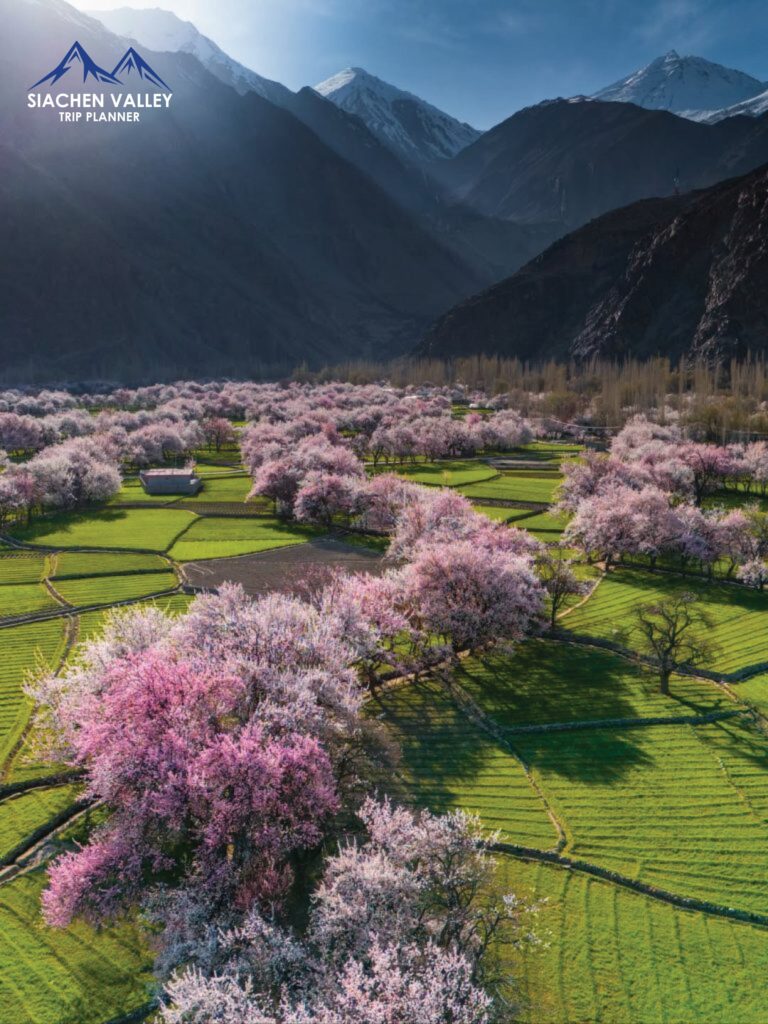
Exploring the Apricot Blossom Season at Baltistan transforms the grandeur of the scenery in the Skardu area of Gilgit-Baltistan into a utopian fantasy every spring, as apricot orchards burst into breathtaking bloom. It is a brief but enchanting season that shades the valleys in light pink and white, which provides a magical experience to the travellers, photographers and nature lovers.
Cultural practices of Apricot (Prunus armeniaca L)
Apricot is a sweet and tasty fruit. Apricots belong to this category of self-fruiting plants, i.e. they do not have to have any pollination companion. The apricot is a plant which has been in use and grown over a long period of time. It is a common ingredient in the cuisines of most countries. They require a chill time of 600 to 900 hours per year at 0 to 8 degrees Celsius. Apricots are not tolerant of low temperatures that are below 0 degrees. They grow best at 37 °C, which is the ideal temperature, though it cannot grow well above that.
Apricots should be planted in loose soil because they do not prefer wet roots. Its soil is supposed to be alkali with pH scale of 6.7-7.5. Apricot varieties which are mostly cultivated in the Baltistan region are i.e Halman, Habi, Ameri & Charmagzi etc. The agriculture statistics (Agri department 2014) reported that total fruit production is 192,992 tones out of which 57,963 tonnes (30%) were wastages & losses. The only Apricot production was reported 125,184 tons of fresh produce annually, out of which 7238 tons fresh consumed & marketed whereas 43,730 tons are wasted annually, which is 43% of the total produce.
When thinning fruits, 2-3 inches are to be left between the fruits. Unless you trim the trees, you may not produce small fruits or may not even bear any. The apricots start bearing fruit after 3-4 years of planting. Late summer should be used to harvest. To determine the readiness of the fruit, hold it and give it a slight twist. If it easily comes off and leaves the stalk, then it is ready. A ripe apricot will be sweet and tender.
The typical issues, which are hazardous to fruits or leaves or the entire tree, are birds, spiders, moths, insects, bacteria, and fungi. You may net the trees to keep the birds off. In the case of other diseases and bacteria, the summer oil, copper oil or tree-friendly sprays, which kill insects, bacteria, and fungi, can be used.
Best Time to Visit
The season of apricot blossom in Skardu normally falls within:
Early April to late April
This is a short time which might change as per the weather conditions but this is the best period to have a glimpse of nature at its best.
Best Place to visit the Apricot Blossom in Skardu
Shigar Valley
A peaceful valley that is full of serene culture and beauty. Shigar is a tranquil, flowered oasis in the middle of the season of blossoms, which has orchards along the riverbanks.
Khaplu
Khaplu has been known to have a family of sweet apricots and the oldest style Balti life, and thus provides thick orchards as well as beautiful scenery, which would be exciting to explore.
Katpana Desert
The only place where flowers and sand dunes collide and form a rare yet beautiful scenery which is appealing to photographers.
Villages around Skardu.
The apricot trees that need to be found in the local villages of Skardu provide authentic experiences like:
- Walking through orchards
- Meeting farmers in the area
- Having the Balti hospitality
A Photographer’s Paradise
The season of apricot blossom is the dream of photo lovers. The gentle colour of the flowers, along with the dramatic mountain backgrounds, allows for never-ending chances of getting splendid shots.
Best photography moments
- Sunset and sunrise amongst blooming orchards.
Mantling of delicate blossoms
- Scenic landscapes (rivers and mountains)
Cultural & Local Experience
It is a season not only of beauty but also of spring and a new start for the surrounding communities. The farmers get ready to harvest the fruits, and the villages are bustling with people.
- Enjoy the old-fashioned Balti culture
- Sample local cuisine and dishes made of apricots
- Get to know about organic farming
Eco-Tourism & Sustainability
Skardu apricot blossom tourism can be considered as eco-friendly tourism because it attracts visitors to explore the rural regions in an environmentally friendly way. It is beneficial to local populations and assists in the maintenance of traditional agriculture.
Travel Tips
- Bring warm clothes.
- Make bookings.
- Adhere to local customs and traditions.
- Go with a local guide to learn more.
Frequently Asked Questions (FAQs)
What is the period of the apricot blossom?
Typically 2-3 weeks, weather conditions depending.
Are the blossoms in Skardu thick?
It is also not as congested as in midsummer, and this makes it a good place to travel without any problems.
Can tourists visit orchards?
Yes, most of the local communities invite guests to visit their orchards.
What is special about Skardu in the blossom season?
It is exceptionally unique because of the beauty of apricot blossoms, snow-crowned mountains, and the scenery such as the cold desert.